





Automotive Carbon Fiber: Which Vehicle Parts Benefit Most from Carbon Fiber Lightweighting?
Automotive Carbon Fiber is often used for automotive lightweighting, but the real value is not simply “how much weight is reduced,” but where that weight is removed. Wheels, body structures, steering wheels, and decorative parts may all use carbon fiber, but the actual effect on the vehicle can be completely different. Determining whether an automotive component is suitable for carbon fiber requires considering the location of weight reduction, load conditions, connection structure, fatigue and impact requirements, as well as actual manufacturing conditions.
Carbon fiber reinforced composites have high specific strength and specific stiffness while maintaining relatively low weight, giving them clear advantages in automotive applications. However, their performance is closely related to fiber orientation, layup structure, resin system, and manufacturing process. Therefore, Automotive Carbon Fiber is not simply about replacing steel or aluminum with a lighter material. The structure needs to be redesigned according to the actual function of the component.
Why Does “Where the Weight Is Reduced” Matter More Than “How Much Weight Is Reduced”?
Weight in different parts of a vehicle does not have the same effect on driving performance. Wheels, tires, braking systems, and some suspension components are part of the unsprung mass. They move rapidly with road surface changes, so changes in their weight can affect suspension response, road-following ability, and overall vehicle dynamics.
Wheels are also rotating components. Reducing wheel weight can not only reduce total vehicle mass but may also reduce rotational inertia. In comparison, removing the same amount of weight from a small interior component usually has much less influence on vehicle dynamics.
Therefore, the value of automotive carbon fiber cannot be judged only by “how many kilograms are saved.” It also depends on where the component is located and what function it performs.
Carbon Fiber Wheels: A Typical High-Value Lightweighting Application
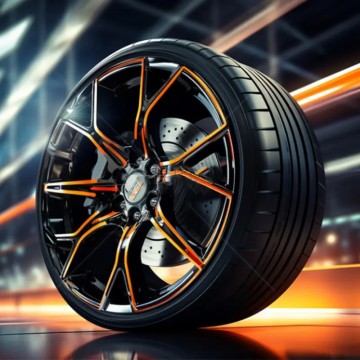
Carbon Fiber Wheels are a typical lightweighting application in the automotive carbon fiber field because wheels are related to both unsprung mass and rotating mass. Reducing wheel weight can lower the moving mass that the suspension needs to control while also reducing inertia in the rotating system. This is one of the reasons high-performance vehicles have long focused on lightweight wheel design.
However, carbon fiber wheels cannot be designed only around the goal of being “lighter.” In actual use, wheels must withstand cornering loads, road impacts, long-term fatigue, and temperature changes. Structural safety and durability are therefore always more important than simply reducing weight.
Fiber orientation, laminate thickness, resin system, rim structure, mounting areas, and metal insert design all affect final performance. If critical load-bearing areas are weakened in order to reduce weight, the material advantages of carbon fiber cannot be converted into reliable vehicle performance.
Therefore, the real value of Carbon Fiber Wheels is not simply “replacing metal wheels with carbon fiber,” but achieving lightweighting through the combined design of material and structure while still meeting structural and durability requirements.
Why Should Carbon Fiber Steering Wheels Be Evaluated Differently?
The application logic of a Carbon Fiber Steering Wheel is completely different from that of a wheel. Even if the steering wheel is made lighter, the effect on vehicle unsprung mass and rotational inertia is very limited. Therefore, its value should not mainly be judged from the perspective of vehicle dynamic performance.
When carbon fiber is used in a steering wheel, stiffness, surface texture, design appearance, and integration with other materials are usually more important. The steering wheel is a component that the driver touches directly for long periods, so grip areas, surface treatment, temperature changes, material connections, and long-term wear all need to be considered.
This also shows that even within Automotive Carbon Fiber, different vehicle parts can have completely different purposes. Wheels focus more on structure and dynamic performance, while steering wheels emphasize design, user experience, and component integration.
Carbon Fiber Metal Parts: When Is a Hybrid Structure More Suitable?
Some automotive components are not suitable for being made entirely from carbon fiber. In these cases, allowing carbon fiber and metal to perform different functions can be more practical.
For example, metal can be retained at mounting points, bolted connection areas, local high-load regions, or positions requiring precision machining, while carbon fiber can be used across larger areas for lightweighting and structural reinforcement. This type of design makes use of the strengths of both materials without sacrificing connection reliability or manufacturing convenience simply for the sake of creating a “full carbon fiber” component.
However, combining carbon fiber with metal also creates additional design challenges. The two materials have different thermal expansion characteristics, deformation behavior, and surface properties, so adhesive bonding, mechanical fastening, and interface design need to be considered in advance.
In addition, carbon fiber is electrically conductive. When it comes into direct contact with certain metals in humid environments, galvanic corrosion may need to be considered. Surface protection, insulation layers, and fastening design can all affect long-term component reliability.
For this reason, products such as Black Carbon Fiber Metal Parts should be treated as complete composite structures rather than simply “carbon fiber plus metal.”
Why Can’t the Original Metal Part Simply Be Copied?
Directly reproducing the same geometry of an existing steel or aluminum part in carbon fiber is a relatively common mistake in automotive composite design.
Metals can often be treated as approximately isotropic materials in many conventional designs, while the strength and stiffness of carbon fiber composites are closely related to fiber direction. Proper layup design can concentrate material performance in the main load directions, but if the fiber orientation does not match the actual load path, obvious weak areas may appear in other directions.
Therefore, a geometry that works well for aluminum is not necessarily the best geometry for carbon fiber. Automotive Carbon Fiber parts should be redesigned according to actual load paths, including fiber direction, number of layers, local reinforcement areas, and connection methods, rather than simply replacing one material with another.
This is one of the biggest differences between carbon fiber lightweighting and ordinary material substitution.
Which Automotive Parts Are More Suitable for Carbon Fiber?
To determine whether a component is suitable for carbon fiber, several key questions should be considered first.
The first question is whether reducing weight in that location creates meaningful value. Unsprung and rotating components such as wheels are usually more important than ordinary interior parts. The second question is what type of load the component carries. Structural parts may need to withstand static loads, impact, and fatigue, while decorative or functional parts may place more emphasis on stiffness, appearance, and long-term use.
In addition, if the part needs to connect with aluminum, steel, or other metals, the mounting areas and material interfaces should be considered in advance. Working temperature, humidity, impact, corrosion, and long-term cyclic loading can also affect the resin system and structural design.
Finally, manufacturing consistency, dimensional accuracy, quality inspection, and maintenance requirements also need to be considered. Only by evaluating these conditions together can it be determined whether a component is better suited to a full carbon fiber structure, a carbon fiber-metal hybrid structure, or another material.
HSBY Automotive Carbon Fiber Products and Project Matching
Hua Sheng Bo Ye (Shenzhen) Technology Co., Ltd. displays carbon fiber products on its website including Carbon Fiber Wheels, Carbon Fiber Steering Wheel, and Black Carbon Fiber Metal Parts, covering wheel applications, driver control components, and carbon fiber-metal hybrid structures.
For an Automotive Carbon Fiber project, simply stating that “carbon fiber parts are needed” is usually not enough to determine a suitable solution. Part type, dimensions, expected load, installation method, operating environment, and surface requirements can all affect material and structural choices. If drawings, dimensions, or specific application information are already available, these details can be provided to HSBY to further confirm a suitable product and structural direction.
Conclusion
The greatest value of Automotive Carbon Fiber does not come from replacing as many automotive components as possible with carbon fiber, but from applying the material where it can create clear practical benefits.
Carbon Fiber Wheels are a typical example because wheel mass affects both unsprung mass and the rotating system. Carbon Fiber Steering Wheels represent a different application logic, where value comes more from stiffness, surface properties, design, and component integration. Carbon Fiber Metal Parts are suitable when carbon fiber and metal need to perform different functions within the same structure.
Therefore, when evaluating whether an automotive part should use carbon fiber, the more important question is not “Can this part be made from carbon fiber?” but rather: “What practical problem can carbon fiber solve in this specific location?”
FAQ
1. Why is Automotive Carbon Fiber commonly used for vehicle lightweighting?
Automotive Carbon Fiber has high specific strength and specific stiffness while maintaining low weight, making it suitable for automotive components that require weight reduction, structural reinforcement, or special design effects.
2. Why is weight reduction in Carbon Fiber Wheels more valuable?
Wheels are part of both the unsprung and rotating systems. Therefore, reducing wheel weight can not only reduce total vehicle mass but may also affect suspension response and rotational inertia.
3. Can an original metal automotive part be directly converted to carbon fiber?
It is generally not recommended to copy the original structure directly. The performance of carbon fiber composites is closely related to fiber orientation, layup structure, and load path, so the component should be redesigned according to actual loading conditions.
4. What information should be provided at the beginning of an Automotive Carbon Fiber project?
It is recommended to provide the part type, dimensions, load conditions, installation method, operating environment, surface requirements, and material connection method. This information helps determine whether a full carbon fiber structure or a hybrid structure is more suitable.