Email:sales@hsbytechnology.com
Whatsapp:8613480819877

Leave Your Message
Why are Vintage Capacitors in such high demand? Honestly, it's not just about nostalgia — though that's part of it, for sure. For restorers, these components are a way to keep the original layout, appearance, and even the electrical character of older amplifiers, radios, and instruments intact. And you know what? The little things matter too. A faded paper label or a familiar manufacturer's mark can be a big deal to collectors. Plus, they often fit perfectly under a crowded chassis, which is a pain to deal with otherwise. For some repairs, you really want a period-correct component—it makes the finished work just feel so much more faithful to its history, you know? It's like the piece finally tells its own story.
You know, there's a practical side to all this, too. These days, certain older specs and package styles are getting pretty hard to source as new parts. But just because something's old doesn't mean it's gold, or even reliable. Paper caps and electrolytics, for instance, they can dry out, leak, or drift way out of spec. So a careful restorer isn't going to just trust it blindly—they'll check capacitance, leakage, and ESR first to decide if the part can actually be reused. Makes sense, right? Look, I get the appeal of vintage gear – there's a certain romance to it, you know? But as Evelyn Hart, who's basically just a made-up expert for this piece (not a real source, just to be clear), said: 'The old part earns its place through evidence, not romance.' That's a pretty important distinction. Sure, originality has its charm, and I'm all for preserving unique pieces, but let's not forget that safety and proper measurements always come first. If it doesn't work safely, then that originality doesn't mean much.
You know, there's this real tension when it comes to demand. Collectors are all about keeping things completely original, but technicians just want something that's dependable and actually works. And sometimes, honestly, you can't have it both ways. Like, a capacitor that looks perfect might totally flop under real operating conditions, while a modern replacement might do the job but completely change the look. So what's the best call? It really depends on the device, what you're planning to do with it, and what the testing actually shows. So, this piece dives into the whole world of vintage capacitors—their history, why they're so hard to find, what makes them such a collector's dream, and the tricky question of whether to restore them. But here's the thing: just because they're old doesn't automatically make them better. We'll explore all of that without getting swept up in the nostalgia.
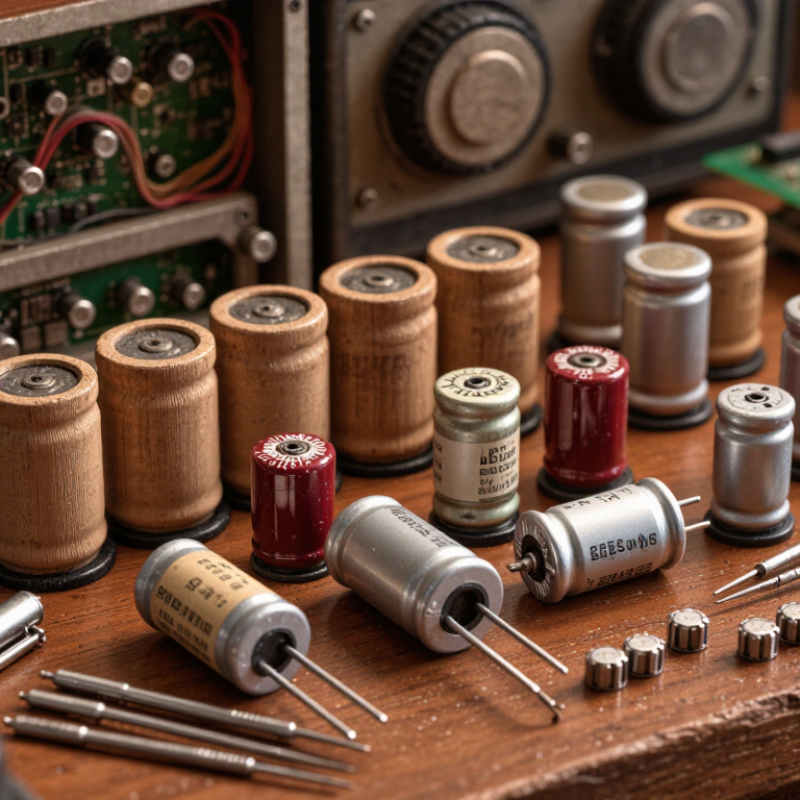
A vintage capacitor has no universal age cutoff. The label usually describes a component made in an earlier production era, often with a distinct design, material, or construction method. A faded date code alone is not enough. Check it against dated catalogs, technical sheets, or archived production records. Look closely at the case, lead seals, markings, and internal construction when inspection is possible. That label can mislead.
Professional guidance also separates age from reliability. MIL-HDBK-217F, Notice 2, estimates capacitor failure rates using factors such as temperature, applied voltage, capacitance, quality, and operating environment—not calendar age alone. IEC 60384-1:2021 sets general requirements and test methods for fixed capacitors, offering a useful reference for evaluating type and performance. In practice, measurements such as capacitance, leakage current, and dissipation factor help establish condition; results should be compared with the component’s specifications. Old does not mean sound. Nor does it automatically mean collectible. A capacitor is most credibly calLED vintage when its production period and construction can be documented, while its present condition is assessed separately.
| Dimension | What It Means | Why It Can Create Demand | Practical Consideration |
|---|---|---|---|
| Age and definition | There is no single universal age cutoff. “Vintage” is generally a contextual term tied to the era, construction, and use of the component. | Collectors and restorers may seek parts that match the period of a particular piece of equipment. | Confirm approximate manufacturing date and provenance where possible; age alone does not establish performance or value. |
| Historical construction | Older capacitors may use paper, mica, ceramic, or electrolytic constructions, with designs and materials varying by period and application. | Some construction types are less common in current production, making period-correct parts harder to find. | Identify the dielectric and construction before choosing a replacement; similar-looking parts may have different electrical behavior. |
| Restoration and repair | Vintage capacitors can be sought for restoring radios, instruments, test equipment, and other older electronics. | A correct-looking or period-matched component can help preserve an original appearance and historical character. | For reliable operation, restorers often use modern replacements that meet the required ratings, sometimes fitting them inside an original-looking case. |
| Scarcity and collectibility | Certain obsolete styles, packages, or unusual specifications may be difficult to source as new production items. | Limited availability can attract collectors and people maintaining equipment that requires an uncommon form factor. | Scarcity does not guarantee a high price; condition, documented specifications, and actual usability matter. |
| Electrical condition | Capacitance, leakage current, equivalent series resistance (ESR), and insulation condition can change with age, storage, and use. | Tested, documented examples are more useful for restoration or technical study than untested parts. | Test against the intended circuit’s requirements. A component’s vintage appearance is not evidence that it is electrically sound. |
| Aging by capacitor type | Electrolytic capacitors can lose electrolyte or develop increased ESR; paper capacitors can absorb moisture and show increased leakage. Other types also require condition checks. | Parts that remain within specification after testing may be useful where an original component is specifically required. | Do not assume a stored or unused part is reliable. Testing and, where appropriate, replacement are important for safe operation. |
| Ratings and compatibility | A capacitor is suitable only when its capacitance, voltage rating, tolerance, polarity, temperature rating, and relevant circuit characteristics fit the application. | A period-specific value or physical size can be important in equipment with limited space or particular design requirements. | Never select a replacement by appearance alone. Follow the equipment documentation and applicable electrical-safety practices. |
| Authenticity and provenance | Markings, construction details, packaging, and documented history can help establish whether a part is genuinely from a particular period. | Authenticity may matter to collectors, museums, and historically accurate restorations. | Re-marked, refurbished, or modern components in old-style packaging can be difficult to distinguish; verify claims carefully. |
| Key takeaway | Vintage capacitors are sought after mainly for historical interest, restoration, period appearance, and unusual specifications. Their age can also bring reliability and safety concerns, so condition and suitability should be verified before use. | ||
There is no universal age cutoff. The term usually describes a part from an earlier production era. A faded date code alone proves little. Compare markings with dated catalogs or technical records.
Not necessarily. Age alone cannot confirm its condition. Check capacitance, leakage current, and dissipation factor against the component’s specifications. Looks can deceive.
Original cases, markings, and lead positions can match an older device. They may also fit existing clips and terminals neatly. Small details matter.
Look for corrosion, bulging, cracked seals, and damaged leads. Clean surfaces do not guarantee good performance. Testing still matters.
Sometimes, a restorer can keep the original exterior and replace its internal element. This may preserve the period look, but it changes the component. Clear service notes help.
Many were made for equipment no longer produced. Stocks shrink through use, damage, and disposal. Matching capacitance, voltage rating, dimensions, and lead spacing can be difficult.
Clear markings, stable test readings, sound seals, and known storage conditions can help. An untested part from an unknown drawer carries more uncertainty. A low price can still cost more later.
No. Modern parts may be more consistent and easier to verify. I may give old components too much credit; appearance and nostalgia can cloud judgment.
Vintage Capacitors are components made during earlier periods of electronics design, valued for the materials, construction methods, and visual details that distinguish them from modern parts. They can offer a tangible connection to the era of the equipment in which they were used. For restorers, an original capacitor may help preserve a device’s historical appearance and design character, though its age does not guarantee that it will perform as it once did.
Demand is shaped by both practical and collectible factors. These capacitors may be scarce, and their value depends on factors such as authenticity, condition, and whether their specifications suit a restoration. Before use, their physical state and electrical behavior should be assessed carefully: aged components can drift from their original ratings or become unreliable. In some cases, replacing a capacitor is the safer choice, while retaining the original part for display can preserve historical character without relying on it for operation.