You've probably noticed automakers can't stop talking about automotive carbon fiber lately — and it's not just hype. With EVs getting heavier and range anxiety still a thing, cutting weight has become a big deal. The International Energy Agency's Global EV Outlook 2024 found that electric-car sales reached nearly 14 million in 2023, which works out to almost one in five cars sold worldwide. That shift is a big reason why lighter materials are suddenly so important. But hey, just cutting down on weight isn't enough to make something genuinely greener—there's more to it than that.
The U.S. Department of Energy says that cutting vehicle weight by 10% can boost fuel economy by 6% to 8%—which is pretty nice. But that number is about lightweighting in general, not carbon fiber specifically. And honestly, that distinction matters. Carbon fiber does give you high strength at low weight, sure. But you also have to think about cost, how much energy it takes to produce, how tricky repairs can get, and what happens at the end of its life. A lighter panel is just one piece of the puzzle.
So, this overview takes a look at ten manufacturers, and honestly, they each bring something different to the table. Names like Toray Industries, Teijin, Mitsubishi Chemical Group, SGL Carbon, Hexcel, and Formosa Plastics all show up—but their strengths are all over the map. Some are really strong in fiber production, others focus more on composite materials, and a few are deep into automotive supply. And since not every company works with the same vehicle programs or markets, trying to rank them simply gets messy pretty fast. So when you look at this comparison, you have to think about things like manufacturing scale, how well they really know their materials, their experience in the automotive world, and whether they can actually keep up with consistent, high-volume production without dropping the ball. Sure, public company info and industry reports can give you some solid clues, but the real product-level data? That's often pretty hard to come by. So yeah, you've gotta take it all with a grain of salt.
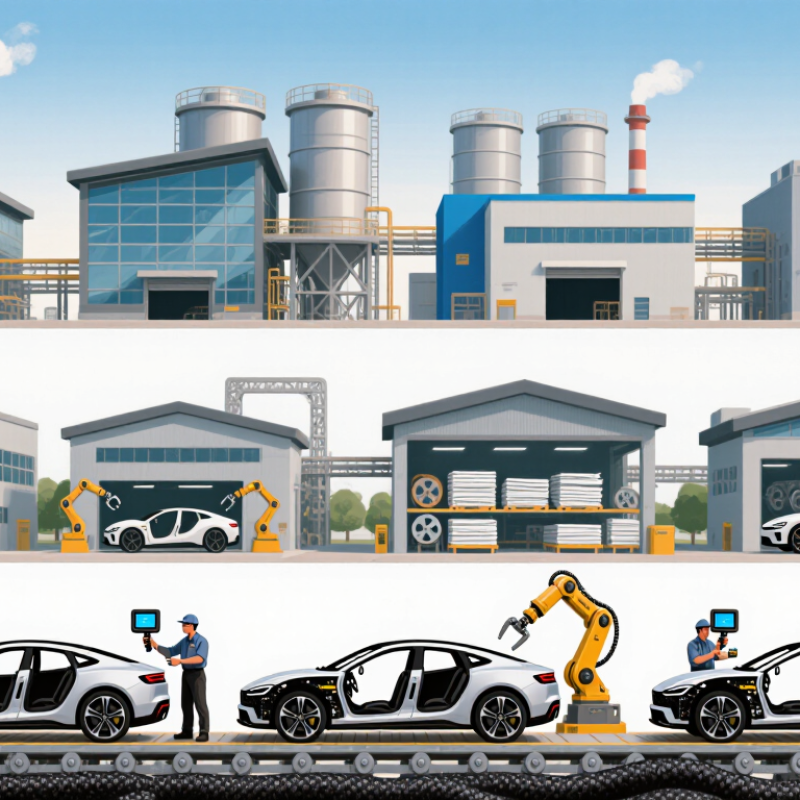
Automotive Carbon Fiber is a composite: thin carbon filaments are bound in a resin matrix to form stiff, lightweight parts. Compared with steel, it can reduce component mass, which matters in a vehicle carrying passengers, batteries, and safety equipment.The U.S. Department of Energy’s Vehicle Technologies Office estimates that a 10% reduction in vehicle weight can improve fuel economy by about 6–8% in conventional vehicles. The exact benefit depends on the vehicle and its design. Small changes add up.
For OEM Automotive Carbon Fiber, the appeal is not weight alone. Carbon-fiber parts can be shaped for stiffness, helping engineers manage loads around body panels, structures, or battery enclosures. Yet production requires energy, specialized processes, and careful quality control. The DOE’s lightweight-materials guidance also highlights cost and manufacturing scale as barriers to wider use. Argonne National Laboratory’s GREET life-cycle model offers a useful reminder: material choices should be assessed across production and vehicle use, not by mass savings alone. A lighter part is not automatically a lower-impact part. Recycling remains difficult, too, because cured resin can complicate fiber recovery. The promise is real, but the trade-offs deserve scrutiny.
Automotive carbon-fiber parts begin with fine filaments bundLED into tows, then arranged as woven fabric or unidirectional sheets. The material is cut into shaped plies, with fiber direction chosen to handle expected loads. This matters around doors, roof panels, and structural components, where stiffness and impact behavior differ. Small placement errors can affect the finished part.
For many applications, manufacturers stack resin-impregnated sheets in a mold, remove trapped air, and cure them under controlled heat and pressure. Other processes inject resin into dry fiber layers. After curing, parts are trimmed and inspected for voids, uneven edges, and surface defects. The sequence sounds tidy; production is not always. A slight temperature variation or wrinkle can require rework, and lightweight construction does not automatically mean lower cost or easier recycling.
Tips: Keep plies clean and correctly aligned. Follow the resin supplier’s cure schedule, and inspect edges after trimming. Record defects, even minor ones. They can reveal a process problem before it repeats.
Comparing automotive carbon fiber manufacturers requires more than checking tensile strength or catalog price. Buyers should examine fiber grade, resin compatibility, laminate consistency, and documented batch variation. Small deviations matter. An uneven weave can change drape, leave resin-rich corners, and complicate trimming on a production line. Request test methods, sample traceability, and repeatability data across several lots. The U.S. Department of Energy’s lightweight-materials guidance estimates that a 10% vehicle-weight reduction can improve fuel economy by roughly 6–8%. That is a potential benefit, not a carbon-fiber guarantee. Part geometry, joining methods, and production losses affect the result.
Production capacity and process speed deserve equal scrutiny. The IEA’s Global EV Outlook 2024 reported nearly 14 million electric-car sales in 2023, about 18% of new-car sales. This growth makes scalable, consistent supply more relevant, though it does not prove every vehicle needs carbon fiber. Ask how suppliers control cure cycles, reject rates, and delivery variation. Check whether reported capacity reflects actual output or an optimistic forecast. A spreadsheet can still flatter a supplier.
For Wholesale Automotive Carbon Fiber purchasing, compare total part cost, not just the quoted material price. Include tooling, scrap, inspection, and finishing. Request evidence from production-scale trials, not only polished sample panels. Sustainability claims also need clear boundaries: ask whether energy use and recycled content refer to fiber, resin, or the finished component. Those distinctions are easy to miss. My own caution: public figures rarely reveal the full cost of a supplier’s process.
A useful profile of ten leading Automotive Carbon Fiber Manufacturers worldwide should compare more than production scale. It should examine fiber grades, precursor sourcing, molding methods, automotive qualification, and regional supply capacity. These details reveal whether a supplier can support both lightweight body panels and high-volume structural parts. The U.S. Department of Energy reports that a 10% reduction in vehicle weight can improve fuel economy by 6% to 8%. That benchmark explains the material’s appeal, but it does not prove every carbon-fiber component delivers the same benefit.
Profiles should also distinguish fiber producers from component makers and vertically integrated suppliers. An Automotive Carbon Fiber Manufacturer may offer strong material consistency, yet still face challenges with cycle time, cost, or repairability. Look for evidence on production capacity and part-level testing, not just headline strength figures. Some public profiles provide limited comparable data. That gap deserves attention.
Automotive carbon-fiber products range from visible body panels to structural components and interior trim. In road vehicles, hoods, roofs, deck lids, and mirror covers can use composite laminates to reduce mass. Door inserts and seat shells may also use carbon-fiber-reinforced materials, where stiffness and surface finish matter. Small details count. Fit matters.
An Automotive Carbon Fiber Factory may produce woven-fabric panels, molded parts, or prepreg components, depending on the design and production volume. Each process brings different requirements for tooling, curing, and quality checks. A glossy panel can look precise yet still need careful inspection for voids, uneven weave, or poor edge finishing. Applications must be tested in the vehicle, not judged by appearance alone. Lighter parts can support efficiency and handling goals, but they do not automatically improve either; design, placement, and the rest of the vehicle matter. Repair can also be more complex than with conventional sheet metal, and replacement may be preferable after certain impacts. That trade-off deserves more attention than it often gets. Some parts are chosen for performance, others mainly for appearance, and the distinction is not always obvious.
| Profile | Typical Manufacturing Focus | Carbon-Fiber Products | Automotive Applications | Common Processing Routes | Industry Fit |
|---|---|---|---|---|---|
| 01 — Large-scale fiber producer | Industrial production of continuous carbon-fiber tow for composite supply chains | Standard- and intermediate-modulus continuous filaments; tow for downstream conversion | Structural reinforcements, body panels, chassis parts, and high-performance vehicle components | Filament winding, pultrusion, weaving, and prepreg conversion by downstream manufacturers | Automotive programs requiring consistent fiber supply and repeatable material properties |
| 02 — Aerospace-grade material specialist | High-performance fibers and tightly controlled composite feedstocks | Continuous tow, unidirectional tape, and qualified prepreg formats | Motorsport structures, supercar monocoques, roof panels, and other weight-sensitive parts | Autoclave curing, out-of-autoclave curing, and automated tape placement | Low-volume vehicles where stiffness, strength, and low mass justify higher material and processing costs |
| 03 — Prepreg and intermediate-material converter | Conversion of reinforcement fiber into ready-to-mold composite materials | Unidirectional prepreg, woven prepreg, and tailored reinforcement kits | Hoods, roofs, deck lids, spoilers, and structural inserts | Compression molding, autoclave processing, and matched-tool curing | Premium and performance vehicles using engineered, production-ready composite materials |
| 04 — Woven and fabric reinforcement producer | Production of textile reinforcements for composite components | Plain, twill, and multiaxial carbon-fiber fabrics | Visible exterior panels, interior trim, seat structures, and locally reinforced components | Resin transfer molding, vacuum infusion, hand lay-up, and prepreg molding | Applications that need drapability, directional reinforcement, or a visible woven surface |
| 05 — Thermoplastic composite materials supplier | Thermoplastic-compatible continuous-fiber reinforcement and composite sheet production | Organosheets, consolidated laminates, and continuous-fiber thermoplastic tapes | Seat structures, brackets, underbody parts, and semi-structural vehicle components | Thermoforming, overmolding, and joining with compatible thermoplastic parts | Programs seeking shorter cycle times, potential recyclability, and integration with thermoplastic molding |
| 06 — Chopped-fiber compound producer | Compounding of discontinuous carbon fiber into moldable polymer materials | Chopped carbon-fiber compounds and short- or long-fiber reinforced pellets | Brackets, housings, interior components, and other molded parts requiring added stiffness | Injection molding and, for suitable compound formats, compression molding | Higher-volume components where complex shapes and molding productivity are important |
| 07 — Carbon-fiber sheet-molding compound producer | Manufacture of moldable composite sheet materials for automotive parts | Carbon-fiber sheet-molding compound and related charge materials | Body panels, closure panels, structural covers, and stiffeners | Compression molding in matched metal dies | Low- to medium-volume parts needing faster molding than conventional hand lay-up routes |
| 08 — Recycled-fiber materials producer | Recovery and reuse of carbon-fiber reinforcement from manufacturing scrap or end-of-life composites | Reclaimed chopped fiber, nonwoven mats, and recycled-fiber compounds | Interior parts, covers, brackets, and non-primary structural components | Compression molding, injection molding, and nonwoven forming | Applications where recycled content and material efficiency are priorities, subject to component performance requirements |
| 09 — Composite component integrator | Design and manufacture of finished carbon-fiber parts using purchased fibers or intermediate materials | Molded laminates, finished panels, structural assemblies, and bonded components | Monocoques, body panels, aerodynamic parts, battery enclosures, and chassis components | Resin transfer molding, vacuum infusion, compression molding, and adhesive bonding | Vehicle makers seeking a component-level supplier with tooling, finishing, and assembly capability |
| 10 — High-rate composite process developer | Materials and manufacturing systems designed around repeatable, faster production cycles | Fast-curing prepregs, tailored blanks, and process-specific reinforcement formats | Roof Modules, closures, structural reinforcements, and selected battery-vehicle components | High-pressure resin transfer molding, rapid compression molding, and automated lay-up | Programs aiming to extend carbon-fiber use beyond very low-volume specialty vehicles |
| Note: The profiles above describe real categories of manufacturers and material suppliers in the automotive carbon-fiber value chain. They are anonymized capability profiles, not named companies or a verified ranking by revenue, production capacity, or market share. Products and applications vary by supplier and vehicle program. | |||||
Automotive carbon fiber can reduce vehicle mass while maintaining stiffness, but scaling it beyond premium, low-volume models remains difficult. Cycle time is a major constraint: curing a composite part can take far longer than stamping steel. Prepreg material also needs controlled storage, and offcuts may be hard to reuse. That is expensive. For manufacturers, the challenge is not simply making a lighter panel; it is producing consistent parts at a price and pace that fit an automotive assembly line.
Emerging approaches include faster-curing resins, automated fiber placement, and recycled carbon fiber for less structurally demanding components. Each brings trade-offs. Recycled fibers may have shorter lengths, which can affect strength and surface finish. Hybrid designs that combine composites with metals can reduce material use, but joining dissimilar materials requires careful testing for fatigue and corrosion. Inspection matters, too: small voids or misplaced fibers may not be visible on a finished surface. Better process monitoring can catch variation earlier, though it adds equipment and data-management costs. The industry’s progress is real, but recyclability and repairability still deserve more attention. A lighter part is not automatically a better one.
Compare fiber grades, precursor sourcing, molding methods, qualification, and regional capacity. Production scale alone is not enough. Some profiles lack comparable data.
A 10% vehicle-weight reduction can improve fuel economy by 6% to 8%, according to the article. Actual results depend on vehicle design and use.
Common examples include hoods, roofs, deck lids, mirror covers, door inserts, and seat shells. Some parts are chosen mainly for appearance.
Suppliers may make woven-fabric panels, molded parts, or prepreg components. Each method has different tooling, curing, and inspection needs. Details matter.
Ask for part-level testing, quality records, and measured cycle times. Inspect edges and surfaces for voids or uneven weave. Appearance alone is not proof.
Composite curing can take longer than steel stamping. Prepreg needs controlled storage, and offcuts may be difficult to reuse. That adds cost.
Faster-curing resins, automated fiber placement, and recycled fibers are being explored. Recycled fibers may be shorter, affecting strength and finish.
Not necessarily. Placement, joining, repair, and the full vehicle design matter. After some impacts, replacement may be preferable. That trade-off deserves more thought.
Automotive Carbon Fiber has become an important material for vehicle design because it combines low weight with high strength, helping manufacturers pursue improved efficiency, performance, and design flexibility. This overview explains what the material is, why it matters, and how it is produced for automotive use, from preparing and processing its constituent fibers to forming components suited to vehicle requirements.
It also outlines the criteria used to compare manufacturers, such as material quality, production capability, consistency, and application expertise, before introducing ten leading producers worldwide without focusing on any single brand. Examples of automotive applications show how carbon fiber can be used across different vehicle components. The article concludes by considering challenges such as cost, manufacturing scale, and recycling, alongside emerging trends that may expand the material’s role in the automotive industry.