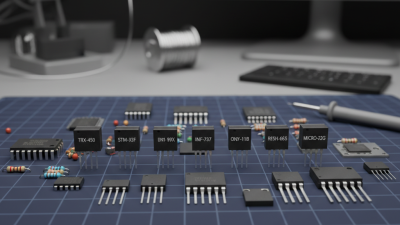
Sourcing the right MOSFETs from around the world isn't just about comparing prices. It's an engineering call—one that involves voltage ratings, current capacity, RDS(on), switching losses, how the part handles heat, packaging, and whether you can actually keep it in stock. A part that looks cheap on a spreadsheet can turn into a heat nightmare once it's inside a crowded inverter enclosure.
Alex Lidow, co-founder and CEO of Efficient Power Conversion, once said, “GaN is the future of power electronics.” It's a good reminder that Semiconductor tech never sits still. That said, traditional silicon MOSFETs are still doing solid work in automotive, industrial, consumer, and energy applications. What's right depends on the circuit, operating frequency, cooling method, and the total system cost—not just the unit price.
This guide offers ten practical tips for finding reliable MOSFETs in international markets. We'll look at authorized distribution, manufacturer reputation, datasheet accuracy, counterfeit risk, lifecycle status, and sample testing. In the real world, sourcing might start with three approved suppliers and a thermal test bench—not a broad online search.
Small details matter, too. Check the date code. Confirm the package marking. Compare the original datasheet with the supplier's file. Ask for traceability documents.
And honestly? There's no perfect sourcing formula.
Regional stock can vanish overnight. A lower unit price can hide higher logistics or failure costs. Even experienced engineers may miss gate-charge behavior when picking a replacement. That's a mistake worth reflecting on. Reliable procurement brings together lab evidence, supplier audits, and careful communication with manufacturers such as Infineon Technologies, onsemi, STMicroelectronics, and Toshiba Electronic Devices & Storage Corporation.

Before contacting global suppliers, define the MOSFET’s real operating conditions. Record drain-source voltage, continuous current, pulse current, switching frequency, and ambient temperature. Include startup surges and fault events. A device rated for 100 volts may fail when a motor creates repeated voltage spikes.
Describe the circuit, not only the component. Note whether the MOSFET handles hard switching, load control, or power conversion. Gate-drive voltage strongly affects conduction loss. Compare RDS(on) at the actual gate voltage, not only the headline value. Check total gate charge, output capacitance, thermal resistance, package limits, and mounting space. Measure the expected heat path through the board and heatsink. Small details matter.
I once selected a low-resistance part without checking switching loss. The prototype ran efficiently at low frequency, then overheated during testing. That mistake changed my sourcing checklist. Ask suppliers for complete electrical curves, production traceability, inspection records, and samples from consistent lots. Verify avalanche ratings, body-diode behavior, and temperature derating independently. Do not trust a single typical value. Test samples across temperature and load ranges. Keep the requirement sheet version-controlLED, because one missing pulse condition can distort every supplier comparison. Perfect specifications are rare. Clear assumptions are better.
Global MOSFET sourcing should begin with electrical evidence, not attractive pricing. Check drain-source voltage, continuous current, pulsed current, gate threshold, and on-resistance under stated test conditions. A low resistance value can mislead when measured at a different gate voltage or temperature. Read the full datasheet.
Thermal performance deserves practical testing. Review junction temperature limits, transient behavior, switching losses, and safe operating areas. Compare datasheet curves with bench results from real loads. Use thermal cameras and controlled airflow when possible. Small differences matter. During supplier evaluation, request production samples, date codes, test reports, and traceability documents. Search terms such as IPW60R080P7XKSA1 MOSFETs Diodes Semiconductor may identify candidate specifications, but the exact part identity still requires verification.
Package selection affects reliability, assembly cost, and heat removal. A through-hole package may simplify manual repair, while a surface-mount option can reduce loop inductance and board area. Check creepage, clearance, lead inductance, solder limits, and mechanical stress. Confirm that the package fits the intended heatsink or automated line. I once underestimated board flex during assembly. The electrical design passed, but solder joints later showed weakness. That mistake reinforced the need for mechanical samples, not only electrical approval. Suppliers should also explain substitution rules, especially when package dimensions or gate-charge characteristics change.
The chart shows representative market ranges for maximum on-state resistance across common voltage classes. Lower-voltage MOSFETs generally achieve lower RDS(on), while higher-voltage devices require greater voltage capability and often have higher conduction losses. During global sourcing, verify the exact VDS rating, test conditions, gate-drive voltage, thermal limits, package parasitics, and qualification requirements in the manufacturer datasheet.
Tip: Verify the manufacturer before reviewing the MOSFET itself. Check its legal registration, factory address, technical support, and published quality system. A polished website proves very little. Request current certificates, production details, and a traceable contact person. Compare these details with independent industry records.
Tip: Treat component authenticity as a physical investigation. Ask for photographs of sealed packaging, date codes, labels, and moisture indicators. Match the lot number with the certificate of conformity. Then inspect samples under magnification. Look for uneven markings, scratched surfaces, bent leads, or inconsistent molding. Small flaws can signal larger problems. Testing should include resistance, leakage, switching behavior, and thermal performance. An independent laboratory adds useful distance.
Tip: Keep every document connected to the purchase order. This includes quotations, packing lists, test reports, and shipping records. One sourcing mistake I made was trusting a familiar-looking label without checking the lot history. The parts passed a basic continuity test but failed under heat. That experience still bothers me. For searches involving OEM Ipw60r080p7xksa1 Mosfets Diodes Semiconductor, confirm the exact specification, package, voltage rating, and revision before accepting substitutions. Do not rely on a distributor’s verbal assurance alone. Ask clear questions, record the replies, and investigate gaps. Some suppliers may resist. That is a warning.
Sourcing the right MOSFET globally requires more than comparing unit prices.
I usually request matched quotations with voltage rating, current rating, package, test conditions, and annual volume clearly stated. A low price may hide higher minimum order quantities, tooling charges, or costly inspection requirements. Ask suppliers to separate component cost, freight, duties, and payment terms.
Lead time needs practical verification. Request production lead time, shipping time, and available inventory as separate figures. A supplier may quote eight weeks, but that can exclude factory scheduling or port delays. Check weekly output, reserved capacity, and allocation policies. A short video call can reveal whether the stated capacity matches actual production equipment and trained staff. Request recent quality records, sample test reports, and traceability documents.
Compare at least three regions using the same specification sheet. One supplier may offer better pricing, while another provides faster replenishment or stronger engineering support. Confirm whether samples come from regular production, not a special trial batch. That assumption often fails. I have seen promising quotes collapse after the first engineering change. Build a small pilot order, inspect electrical performance, and monitor delivery accuracy before committing to larger volumes. Keep a written scorecard for price, lead time, capacity, defect rate, and communication speed. Real sourcing is rarely perfect. Review the scorecard every quarter.
Global MOSFET sourcing needs more than a low quotation. The WSTS Autumn 2024 forecast valued worldwide semiconductor sales at about US$588 billion for 2024. High demand can pressure inspection capacity. Quality systems therefore deserve early review. Ask suppliers for ISO 9001 certification, process-change controls, calibration records, and documented corrective actions. Certificates alone are not proof.
Tip 1: Audit the process, not just the paperwork. Request sample production records, incoming inspection limits, and failure-analysis reports. For automotive applications, check relevant IATF 16949 controls and AEC-Q101 testing evidence. Independent electrical testing should verify breakdown voltage, RDS(on), leakage, and switching performance. A few samples are useful, but never enough.
Tip 2: Build traceability into every purchase order. Record wafer source, assembly site, date code, lot number, test program, and certificate of conformity. Confirm RoHS, REACH, and applicable export documentation before shipment. For searches involving “Wholesale Ipw60r080p7xksa1 Mosfets Diodes Semiconductor,” compare marking quality, package dimensions, and curve data against the approved specification. The 2024 SIA State of the Industry report highlights the semiconductor sector’s complex, globally distributed supply chain. That complexity increases handoff risks. Tip 3: Use independent laboratories for disputed lots. Optical inspection can miss altered markings. Electrical screening can miss long-term drift. I have seen clean paperwork hide weak sampling plans. That possibility deserves review.
| Tip | Assessment Dimension | What to Verify | Recommended Evidence or Benchmark | Why It Matters | Common Red Flags |
|---|---|---|---|---|---|
| 1 | Quality management system | Confirm that the manufacturing site operates a documented and audited quality management system covering design control, process control, corrective action, change management, and nonconforming product handling. | ISO 9001:2015 certification is a general baseline. For automotive applications, verify the relevant production site and scope under IATF 16949, where applicable. | A certified system helps reduce process variation and provides a formal method for investigating failures and preventing recurrence. | Certificate issued to a different site, expired certificate, unclear scope, or inability to provide recent audit findings and corrective-action records. |
| 2 | Electrical specification control | Compare the datasheet, drawing, purchase specification, and certificate of conformity for drain-source voltage, continuous drain current, on-resistance, gate threshold voltage, gate charge, leakage current, and thermal limits. | Require a controlled revision level and defined test conditions, such as junction temperature, gate voltage, pulse duration, and case or board mounting method. Do not compare typical values with guaranteed limits. | MOSFET parameters are highly dependent on temperature, test setup, and production distribution. Incorrect comparisons can create thermal or switching failures. | Typical values presented as guaranteed limits, missing test conditions, inconsistent revisions, or specifications that do not match the purchase order. |
| 3 | Qualification and reliability testing | Review package and technology qualification data for temperature cycling, high-temperature operating life, humidity, electrical overstress, and mechanical robustness. | For automotive discrete semiconductors, ask whether qualification follows the applicable requirements of AEC-Q101. Common supporting methods include JESD22-A104 for temperature cycling, JESD22-A108 for operating life, and JESD22-A110 for HAST, when applicable. | Qualification testing exposes failure mechanisms related to package construction, die attach, wire bonds, moisture, thermal expansion, and long-term electrical stress. | Uncontrolled summary charts, no sample size or failure criteria, qualification performed on a different package, or data that cannot be linked to the proposed part number. |
| 4 | Incoming and outgoing electrical testing | Define production-screening requirements for static and dynamic characteristics, including breakdown voltage, leakage, on-resistance, gate charge, switching behavior, and body-diode performance where relevant. | Request lot-level test summaries, test limits, measurement equipment identification, calibration status, and yield data. Test conditions should match the approved product specification. | Electrical testing verifies that the shipped population meets the required limits and can reveal process drift before products reach the customer. | Only sample testing without a documented sampling plan, missing test limits, manual data without traceability, or unusually perfect results with no distribution information. |
| 5 | Lot and date-code traceability | Ensure each shipment can be traced from the external label to the wafer lot, assembly lot, test lot, manufacturing site, production date, and inspection records. | 100% of shipping units should carry a readable lot or date code linked to retained manufacturing records. Agree in advance on date-code format, shelf-life rules, and mixed-lot controls. | Traceability enables targeted containment, faster root-cause analysis, and controlled recalls instead of broad and expensive product holds. | Relabeled packaging, missing or inconsistent date codes, mixed lots without disclosure, unexplained gaps in production history, or inability to provide records within an agreed response time. |
| 6 | Change notification and configuration control | Establish controls for changes to wafer fabrication, assembly location, materials, package design, test limits, tooling, subcontractors, and production process parameters. | Require a documented Product Change Notification (PCN) process with affected part numbers, reason for change, implementation date, qualification plan, and customer approval requirements. Define notice periods contractually. | A process or material change can alter electrical performance, reliability, thermal behavior, or regulatory status even when the commercial part number remains unchanged. | Change notices issued after shipment, no last-time-buy option, vague descriptions, no comparative qualification data, or changes made without revision control. |
| 7 | Authenticity and supply-chain integrity | Control the distribution path, packaging condition, label consistency, storage history, and chain of custody from the original manufacturing source to the purchasing organization. | Use approved channels where possible, require certificates of conformity and packing records, and perform independent verification for high-risk or shortage-period purchases. Inspect markings, package dimensions, lead finish, and moisture indicators. | Unauthorized distribution and remarking can introduce counterfeit, recycled, remarked, or mishandled components into production. | Unusually low pricing, broken factory packaging, altered labels, sanding or resurfacing marks, inconsistent molding compounds, mixed packaging formats, or pressure to avoid inspection. |
| 8 | Moisture, handling, and storage controls | Verify moisture sensitivity level, floor life, sealed-bag condition, bake requirements, storage temperature and humidity, and electrostatic discharge controls. | For surface-mount packages, request the applicable moisture classification under J-STD-020 and handling records based on J-STD-033, when applicable. Require ESD controls aligned with ANSI/ESD S20.20 or an equivalent documented program. | Moisture and ESD damage may not be visible at incoming inspection but can cause delamination, package cracking, latent leakage, or early electrical failure during assembly and operation. | Open moisture-barrier bags without exposure records, missing humidity indicators, uncontrolled warehouse conditions, or no evidence of ESD training and periodic verification. |
| 9 | Environmental and material compliance | Check restrictions on hazardous substances, chemical content declarations, restricted substances in packaging, and mineral sourcing information relevant to the destination market and application. | Request current declarations for EU RoHS Directive 2011/65/EU and applicable amendments, REACH Regulation (EC) No 1907/2006, and conflict-minerals reporting based on the applicable customer or jurisdictional requirements. Verify exemption claims and revision dates. | Noncompliant materials can block customs clearance, prevent customer qualification, create product recalls, and expose the buyer to legal or contractual risk. | Generic declarations with no part-number scope, outdated documents, unsupported exemption claims, missing substance thresholds, or refusal to disclose material information under a confidentiality agreement. |
| 10 | Supplier performance and continuous monitoring | Evaluate delivery reliability, defect rates, corrective-action response, complaint handling, capacity planning, business continuity, and financial or operational resilience. | Use measurable supplier KPIs such as on-time delivery, incoming defect rate, response time for containment, corrective-action closure time, and PCN compliance. Require structured root-cause analysis, such as 8D, for significant failures. | Supplier quality is a continuing risk. A capable initial audit does not guarantee stable performance during capacity expansion, shortages, or process transfers. | Repeated late deliveries, incomplete corrective actions, unexplained quality deterioration, capacity promises without evidence, or inability to support an approved second source. |
10 Tips for Sourcing the Right MOSFETs Globally
Manage Logistics, Import Regulations, and Supply Chain Risks
Global MOSFET sourcing requires more than comparing unit prices. Confirm the exact part number, voltage rating, current capacity, package type, and lifecycle status. Request traceability documents, test reports, and a clear country of origin. A lower price may hide costly verification work. It happens.
Before placing an order, verify the correct HS code with a qualified customs professional. Import duties, value-added taxes, labeling rules, and licensing requirements can differ by destination. Check whether the shipment needs safety declarations or technical documents. Keep commercial invoices, packing lists, and certificates consistent. Small errors can delay a pallet for days. Use clear Incoterms, realistic delivery dates, and cargo insurance suited to the shipment value.
Supply chain resilience needs practical planning. Approve at least two qualified sources when design rules allow it, but do not assume interchangeable MOSFETs behave identically. Compare electrical curves, thermal performance, and test conditions. Hold a modest safety stock for critical production lines, especially before regional holidays or severe weather seasons. Inspect moisture protection, packaging labels, and date codes when goods arrive. Record every batch in your inventory system.
One weakness remains common: teams often trust forecasts too much. Review demand monthly, monitor supplier capacity, and maintain an escalation contact. A documented backup plan is useful, but an untested plan is only paperwork.
Global MOSFET sourcing becomes safer when sampling is treated as evidence, not paperwork. Request samples from defined production lots, not only engineering stock. Record lot codes, package markings, date codes, and storage conditions. Test gate threshold, on-resistance, leakage, switching loss, and thermal behavior. Use the same fixture and temperature limits for every supplier. Small details matter. A damaged reel can distort results.
Qualification should combine documents with physical testing. Review datasheets, change-control procedures, process capability data, and traceability records. Ask for material declarations and relevant compliance evidence before approval. In the laboratory, test devices under normal and stressed conditions. Inspect solderability and package integrity after handling. Compare results against application limits, not attractive typical values. One weak sample does not prove failure, but it deserves investigation. We once underestimated connector resistance; the measurement looked worse than the device.
A long-term supplier review needs a fixed rhythm, perhaps quarterly and annually. Track yield, delivery consistency, corrective-action speed, field returns, and unauthorized substitutions. Re-sample after process, site, or material changes. Keep approved alternatives technically equivalent, with separate qualification records. Search terms such as Ipw60r080p7xksa1 Mosfets Diodes Semiconductor Manufacturer should never replace technical verification. Our checklist still misses details sometimes. Review it after every incident, even minor ones. Supplier meetings should include engineers, quality staff, and procurement specialists. That mix exposes risks earlier.
Check drain-source voltage, continuous current, pulsed current, gate threshold, and on-resistance. Read the full datasheet.
The value may use a different gate voltage or temperature. Compare measurements under identical test conditions.
Review junction limits, switching losses, transient behavior, and safe operating areas. Compare curves with bench tests on real loads.
Use thermal cameras and controlled airflow when possible. Small differences matter.
Check creepage, clearance, lead inductance, solder limits, and mechanical stress. Confirm heatsink and automated-line compatibility.
Electrical approval may miss board flex or weak solder joints. I once underestimated assembly stress. That mistake still matters.
Request samples from defined production lots, not only engineering stock. Record lot codes, markings, date codes, and storage conditions.
Test gate threshold, on-resistance, leakage, switching loss, thermal behavior, solderability, and package integrity. Use the same fixture for every supplier.
Review delivery consistency, yield, corrective-action speed, field returns, and substitutions quarterly or annually. Re-sample after process or material changes.
No checklist is perfect. Ours still misses details sometimes. Review it after every incident, even a minor one.
Sourcing the right Mosfets globally starts with clearly defining the application, voltage, current, switching frequency, thermal conditions, and operating environment. Buyers should compare electrical ratings, efficiency, switching performance, reliability, and package options to ensure the components match both design and manufacturing requirements. It is also important to verify supplier credentials, production capabilities, product authenticity, and documentation before placing orders.
A dependable sourcing strategy should evaluate pricing, lead times, capacity, quality systems, testing procedures, traceability, and regulatory compliance. Logistics planning should include shipping conditions, import requirements, inventory risks, and backup supply options. Before long-term cooperation, buyers should establish a structured process for sampling, technical qualification, inspection, and performance validation. Regular supplier reviews can help monitor quality consistency, delivery performance, production changes, and future demand support, reducing supply disruptions while improving overall cost control and product reliability.