Picking out INFINEON Modules for global sourcing isn’t just about comparing prices per unit. It’s really a bit more nuanced — engineers need to consider the voltage class, current capacity, switching frequency, package design, and cooling conditions. Sometimes, a module that works perfectly in a lab might not hold up so well in a dusty factory cabinet, so you’ve gotta think about the actual environment.
When you’re doing a practical sourcing project, the best starting point is really the application itself. Lay out the inverter topology, the motor profile, ambient temperatures, the load cycles you expect, and what failure rate is acceptable. Then dive into Infineon’s datasheets, application notes, qualification info, and lifecycle notices. Also, make sure you verify the distributor’s traceability — counterfeit protection is super important.
As Peter Wawer, a well-respected power Semiconductor expert at Infineon, once said, “Silicon carbide is a key technology for decarbonization.” That’s a pretty big deal in the industry. SiC modules can cut down on switching losses and cooling needs, but they might also need different gate-drive settings or layout tweaks. Remember, tech choices aren’t made in isolation — everything’s interconnected.
When evaluating suppliers, don’t forget to check regional inventory, the level of tech support, warranty policies, and whether they’ve got a solid second-source plan. It’s worth asking if the samples, production units, and replacements are all the same specs — tiny differences can add up and become costly.
And yeah, price is just one piece of the puzzle.
Even a spreadsheet can be misleading. I’ve seen cases where folks picked a cheaper module before finishing thermal testing — which might save some cash on paper but can end up costing more in the long run when it’s actually running in the real world. It’s crucial for global buyers to ask for real test data, scrutinize the supply chain, and think about total ownership costs. The final call should strike a balance between efficiency, reliability, availability, and confidence in the engineering — it’s never a perfect science, but it’s certainly more reliable than just chasing the lowest quote.
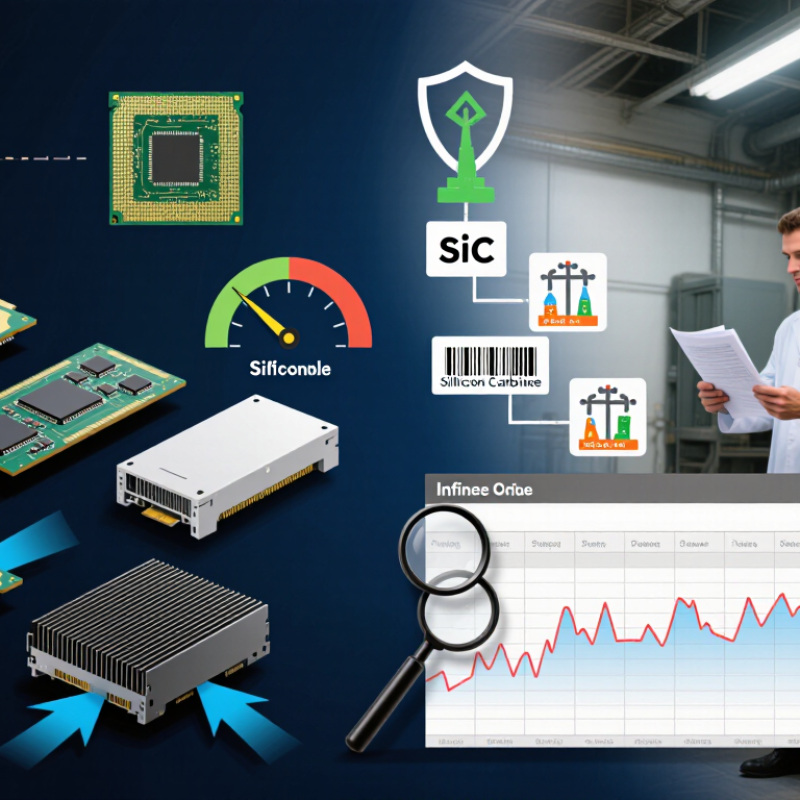
Choosing a power module starts with the load, not the catalog. Define the application in practical terms: motor drive, solar inverter, server supply, or industrial controller. Record input voltage, output current, switching frequency, duty cycle, and expected load profile. Include ambient temperature, airflow, humidity, vibration, and enclosure limits. These details reveal requirements that product tables often hide. A module rated for 40 amperes may still fail inside a seaLED cabinet.
Keep margins realistic. Translate the application into measurable electrical limits. Check voltage overshoot, conduction loss, switching loss, isolation rating, thermal resistance, and short-circuit behavior. Estimate junction temperature during normal and fault conditions. Confirm package dimensions, pin arrangement, mounting method, and gate-drive conditions. Request test reports, traceability records, lifecycle information, and change-notification procedures. Experienced engineers should compare datasheets with bench results, rather than relying on claims alone.
When screening global suppliers, use the complete part reference as a search lead. For example, BSC007N04LS6ATMA1 INFINEON Agent may appear in a sourcing query. Then verify the actual manufacturer and supply path. Check date codes, packaging, factory seals, and independent inspection options. I once treated a “drop-in” replacement as electrically equivalent. Its thermal behavior was different. That assumption cost redesign time. Keep a written qualification matrix and test samples across temperature and load. Requirements may change after testing. That is normal, but undocumented changes create procurement risk.
Choosing the right module category starts with the application, not the supplier list. Map voltage, current, switching frequency, thermal limits, and package constraints. A 48-volt motor controller needs different protection from a 1,200-volt solar inverter. A discrete MOSFET may suit compact control boards, while a power module can simplify high-current switching and cooling.
The IEA’s Global EV Outlook 2025 reported more than 17 million electric cars sold worldwide in 2024. This growth increases demand for efficient traction inverters, onboard chargers, and battery protection systems. For lower-voltage, high-frequency designs, examine MOSFET categories first. Search records should preserve exact identifiers, such as AUIRFR6215TRL MOSFET Infineon, then verify voltage rating, RDS(on), gate charge, and lifecycle status. Do not rely on the title alone.
For industrial drives and renewable-energy converters, compare IGBT, silicon-carbide, and integrated power-module categories. The IEA’s Renewables 2024 report projected almost 6,000 GW of renewable capacity additions during 2024–2030. That scale makes thermal performance and field service critical. Check datasheets, application notes, test conditions, and independent qualification records. Supplier claims can be technically correct but still incomplete. I once treated a lower RDS(on) value as the obvious advantage, then found its switching losses were higher at the actual operating frequency. That mistake remains useful. Compare like for like. Ask for traceability, regional stock, authorized channels, and replacement compatibility before approving a global sourcing path.
Select the module category by matching its typical voltage capability with the application’s DC-link voltage, switching requirements, thermal design, and regional supply availability.
The chart shows representative industry voltage bands in volts. Actual ratings, package formats, current capability, qualification standards, and availability must be verified in the supplier’s latest datasheet.
Global sourcing of power modules should begin with electrical comparison, not catalog price. Check voltage and current ratings under the same switching frequency, gate resistance, and cooling conditions. A 1,200-volt rating means little if switching losses rise sharply at the target current. Compare conduction loss, turn-on and turn-off energy, short-circuit withstand time, and creepage distance. The WSTS Spring 2024 forecast valued the global semiconductor market at about 611 billion US dollars, with strong recovery expected. That growth increases choice, but not necessarily interchangeability.
Thermal data often separates a reliable design from an expensive field failure. Compare junction-to-case resistance, transient thermal impedance, maximum junction temperature, and power-cycling capability. Use the same thermal interface material and mounting pressure during tests. JEDEC JESD51 guidance shows why board, case, and junction measurements cannot be treated as identical. A heat sink may feel cool while the silicon remains dangerously hot. Imperfect models happen. Verify them with thermocouples, thermal imaging, and double-pulse tests.
Mechanical specifications deserve equal attention. Check package envelope, terminal position, mounting-hole tolerance, baseplate flatness, recommended torque, vibration limits, and creepage layout. A two-millimeter height difference can break an automated assembly fixture. The IEA Global EV Outlook 2024 reported more than 14 million electric-car sales in 2023, highlighting how quickly power-electronics production is scaling. Still, a global supplier should provide traceable test conditions, revision control, and consistent drawings. Datasheet confidence alone is not enough.
A brand-neutral comparison framework for selecting power semiconductor modules by application, operating conditions, and supply-chain requirements.
| Module Profile | Typical Topology | Blocking Voltage | Continuous Current Range | Recommended Switching Range | Conduction Characteristic | Thermal Performance | Operating Temperature | Mechanical Format |
|---|---|---|---|---|---|---|---|---|
| 650 V Silicon Carbide MOSFET Module High frequency Low loss | Half-bridge or six-pack | 650 V DC bus class | 30–150 A at the specified case temperature | 20–100 kHz, depending on cooling and gate-drive design | Low channel resistance; low reverse-recovery impact when paired with suitable commutation design | Typical junction-to-case resistance: 0.10–0.35 K/W; requires low-inductance layout and controlled thermal interface | −40 °C to +175 °C junction capability is common | Isolated baseplate or molded power package; screw terminals or press-fit power contacts |
| 1200 V Silicon IGBT Module Industrial inverter Cost balanced | Half-bridge, chopper, or six-pack | 1200 V DC bus class | 25–150 A at the specified case temperature | 2–20 kHz for motor drives, UPS systems, and industrial converters | Specified by collector-emitter saturation voltage and switching energy; soft-switching can reduce losses | Typical junction-to-case resistance: 0.10–0.35 K/W; thermal grease, phase-change material, or an equivalent interface may be required | −40 °C to +150 °C is common; some designs support higher junction limits | Standard insulated baseplate module with mounting holes and separate gate, emitter, and collector terminals |
| 1200 V Silicon Carbide MOSFET Module High efficiency Fast switching | Half-bridge or dual-switch | 1200 V DC bus class | 20–100 A at the specified case temperature | 20–100 kHz in high-efficiency converters; actual limit depends on gate loop and EMI control | Low switching energy and low reverse-recovery charge; requires careful negative-gate-voltage and overshoot management | Typical junction-to-case resistance: 0.08–0.30 K/W; low parasitic inductance is important for reliable operation | −40 °C to +175 °C junction capability is common | Compact baseplate, low-inductance module, or molded package with Kelvin-source control connection |
| 1200 V Fast-Recovery Diode Module Rectifier Freewheel path | Dual diode, bridge, or diode pair | 1200 V repetitive peak voltage class | 30–300 A average or controlled RMS current, depending on duty cycle and cooling | Up to approximately 20–40 kHz in suitable soft-switching or controlled-recovery applications | Defined by forward voltage, reverse-recovery charge, and reverse-recovery current; soft-recovery behavior reduces electrical stress | Typical junction-to-case resistance: 0.08–0.40 K/W; heatsink sizing must include forward and recovery losses | −40 °C to +150 °C is common | Isolated baseplate or stud-style power package; polarity and terminal arrangement must be checked carefully |
| 1700 V Silicon IGBT Module High-voltage drive Grid conversion | Half-bridge or three-phase inverter leg | 1700 V DC bus class | 25–100 A at the specified case temperature | 1–10 kHz, commonly used where voltage margin is prioritized over switching frequency | Higher voltage rating generally involves a trade-off between saturation voltage and switching energy | Typical junction-to-case resistance: 0.12–0.45 K/W; insulation rating and creepage distance require application review | −40 °C to +150 °C is common | Larger insulated baseplate module; confirm terminal spacing, isolation distance, and mounting-hole pattern |
| 650 V Silicon IGBT Module Compact inverter Appliance drive | Six-pack or three-phase inverter | 650 V DC bus class | 10–100 A at the specified case temperature | 4–20 kHz for compact motor drives and power supplies | Balanced saturation voltage and switching energy; suitable for moderate-frequency hard-switching designs | Typical junction-to-case resistance: 0.15–0.60 K/W; airflow and heatsink flatness strongly affect thermal margin | −40 °C to +150 °C is common | Compact molded or insulated-baseplate module; integrated temperature-sensing options may be available |
Selection note: The ranges shown are representative industry values for common module classes rather than a substitute for a qualified component datasheet. Before global sourcing, verify electrical ratings at the intended switching frequency, thermal impedance under the actual mounting method, isolation and creepage requirements, package drawings, end-of-life status, compliance documentation, and second-source availability.
When selecting modules for global sourcing, authenticity must be checked before price. Request high-resolution photos of package markings, date codes, pin alignment, and moisture indicators. Compare them with official technical documents and approved distributor records. Do not rely on a supplier’s logo, website, or verbal assurance. Ask for purchase invoices, certificates of conformity, and the full lot history. Small inconsistencies matter. A changed font or uneven molding can signal relabeling, storage damage, or a simple documentation error.
Quality verification should reflect the module’s real working conditions. Review electrical test data, insulation results, thermal resistance, and switching performance. For high-current parts, check connector surfaces and run controlled load tests through an independent laboratory. Keep samples from each lot, not only the first shipment. A clean report helps, but it is not proof by itself. Test methods, equipment calibration, and acceptance limits must be visible. Visual inspection alone is weak.
Supplier traceability links every unit to a source, warehouse, shipment, and responsible contact. Request serial-level records where available, plus storage temperature logs and transport details. Confirm that replacement stock comes from the same approved channel. Record findings in a traceability file that procurement and engineering can review together. No checklist is perfect. In one review, a missing warehouse transfer date looked harmless, yet it delayed the approval decision. That was inconvenient, but useful. It showed where our process needed stronger evidence.
Global sourcing of power modules requires more than checking a distributor’s stock badge. Compare regional availability, landed pricing, and confirmed lead times at the same time. WSTS forecast global semiconductor sales at 611 billion dollars for 2024, representing 16% annual growth. Strong demand can quickly tighten popular voltage and current classes.
Request quotations from at least three authorized channels across North America, Europe, and Asia. Record currency, taxes, freight, minimum order quantity, and date-code requirements. A low unit price may become expensive after air freight and customs processing. Check factory allocation, not only warehouse inventory. For example, a supplier showing 2,000 units may have only 300 units available for immediate shipment. Get written confirmation.
Lead-time evidence should come from recent purchase orders and supplier capacity statements. Industry surveys from ECIA and supply-chain analysts consistently show that component lead times can vary sharply by category and quarter. Use a rolling spreadsheet with weekly updates. The phrase OEM Bsc007n04ls6atma1 Infineon Agent may attract offers, but it does not prove authenticity or supply authority. Verify traceability, inspection records, and approved sourcing status. WSTS data is useful for market direction, yet it cannot predict one module’s delivery date. I would also challenge my own forecast. A six-week estimate may fail after one allocation change. Keep a qualified second source. Never assume the cheapest quote is the safest one.
How to Choose Infineon Modules for Global Sourcing?
Compliance should be checked before price negotiations begin. Request certificates, lot traceability, country-of-origin data, and current environmental declarations. A supplier’s PDF may look complete, yet its revision date could be several years old. Confirm whether documentation matches the exact part number and package. For the search term “Wholesale Bsc007n04ls6atma1 Infineon Agent,” treat every listing as an unverified lead, not proof of authorization. Ask for recent invoices, factory packaging photos, and a traceable supply route. Small details matter. A mismatched label can stop customs clearance or trigger an internal quality hold.
Support quality also deserves measurable checks. Ask how quickly technical questions receive answers, and who handles failure analysis. Good support can provide application notes, test conditions, storage guidance, and change notifications. Request sample units from the same production lot as the proposed order. Compare markings under magnification. Record electrical results, not just visual impressions. This process feels slow, especially when production deadlines are tight. Still, rushed approval creates expensive uncertainty.
Long-term supply risk needs more than a stock statement. Review lifecycle status, planned production windows, minimum order quantities, and approved alternatives. Build a second-source strategy where the design allows it. Monitor lead-time changes every month, using written updates rather than informal promises. I have seen purchasing teams trust one distributor too early, then discover that allocation rules changed without warning. That mistake is easy to repeat. A practical risk file should show buffer stock, escalation contacts, replacement testing, and the date each assumption was last checked.
Verify authenticity first.
Ask for purchase invoices, conformity certificates, and complete lot histories. Supplier logos and verbal promises are not enough.
Watch for changed fonts, uneven molding, damaged packaging, or inconsistent markings. These details may suggest relabeling or poor storage.
Review electrical data, insulation results, thermal resistance, and switching performance. Visual inspection alone is weak.
Inspect connector surfaces carefully. Use controlled load tests through an independent laboratory when practical. Keep samples from every lot.
Link each unit to its source, warehouse, shipment, and responsible contact. Request serial-level records, storage logs, and transport details.
Compare at least three approved channels across different regions. Include currency, taxes, freight, minimum orders, and date-code requirements.
Air freight and customs may increase the landed cost. A listed quantity of 2,000 units may include only 300 units ready to ship.
Request recent purchase orders and supplier capacity statements. Update a weekly spreadsheet. A six-week estimate can fail after one allocation change.
Record every finding in a shared traceability file. A missing warehouse transfer date once delayed approval. It seemed minor, but it exposed a weak process.
Choosing Infineon Modules for global sourcing requires a structured evaluation based on both technical needs and supply-chain priorities. Begin by clearly defining the application, operating environment, power requirements, switching performance, cooling conditions, and installation constraints. Then select the most suitable module category and compare electrical ratings, thermal behavior, mechanical dimensions, reliability indicators, and compatibility with the wider system. These details help ensure that the selected module can perform efficiently and consistently throughout its intended service life.
Beyond technical specifications, buyers should verify product authenticity, quality documentation, and supplier traceability. It is also important to assess global availability, pricing stability, lead times, inventory flexibility, and the risk of future shortages. Finally, review compliance documentation, technical support, warranty conditions, and long-term supply plans. A balanced decision that combines performance, quality assurance, logistics, and lifecycle considerations can reduce sourcing risks and support reliable production across international markets.